Tragulus
nigricans
Balabac chevrotain |
Taxonomy | Description
| Reproduction | Ecology
| Behavior | Distribution
| Conservation | Remarks
| Literature |
| Taxonomy
-
Tragulus nigricans [Thomas, 1892].
-
Citation: Annals and Magazine of Natural History, Series 6, vol. ix:
254.
-
Type locality: Balabac, Philippines.
The original taxonomic reference (above) is taken from Lydekker (1915).
This species, frequently reported as a subspecies of
Tragulus napu, was resurrected as
a distinct species in 2004 based on skull morpholgy (see Meijaard and Groves,
2004), although several authors prior to this distinguished the Balabac
chevrotain as a full species (see, for example, Rabor, 1977). T.
nigricans was originally allied with T. napu due to similarities
in body size and markings, although Meijaard and Groves (2004) suggest that
it may be more closely related to T. javanicus. .Nevertheless, these
authors have kept T. nigricans in close association with T. napu.
Skull measurements demonstrate clear differentiation between T.
nigricans and both T. napu and the T. javanicus
complex (Meijaard and Groves, 2004). This species was incorrectly referred
to as Muntiacus nigricans by Allen and White (1910); otherwise there
are no synonyms. Endemic to a single island in the Philippines, the
Balabac chevrotain has no subspecies.
General Characteristics
The Balabac chevrotain, like all members of the family Tragulidae, is very
small in stature (Rabor, 1977). This species is smaller than T.
napu from neighbouring Borneo (Meijaard and Groves, 2004). Head
and body length for T. nigricans is approximately 40-50 cm; shoulder
height is approximately 18 cm. No live weights for this species have been
reported.
Reported measurements for Balabac chevrotain (Tragulus
nigricans) |
| Source |
Adult Weight |
Head & Body Length |
Shoulder Height
|
Tail Length |
| Allan and White, 1910 |
- |
47.5 cm 
(n=1, from skin) |
- |
6.5 cm 
(n=1, from skin) |
Nowak, 1991
for Tragulus |
0.7-8.0 kg |
40.0-75.0 cm |
20-35 cm |
2.5-12.5 cm |
| Rabor, 1977 |
- |
41.0 cm 
40.0 cm  |
18.0 cm 
17.7 cm  |
8.0 cm 
7.5 cm  |
| Rabor, 1986 |
- |
49.0-55.0 cm 
47.5-48.0 cm 
("total length" including tail) |
18.0-18.5 cm 
17.7-18.5 cm  |
8.0-8.5 cm 
7.5-8.0 cm  |
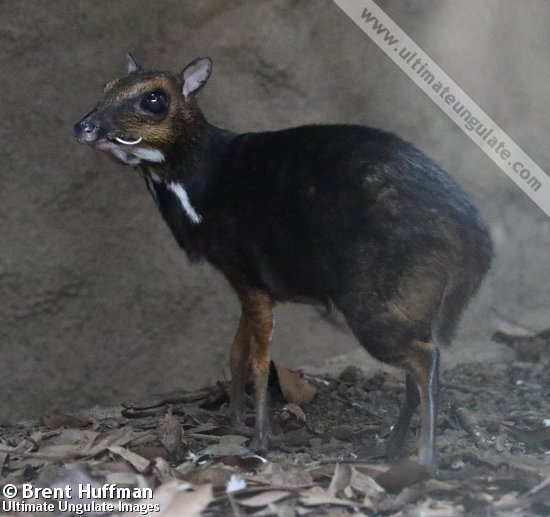
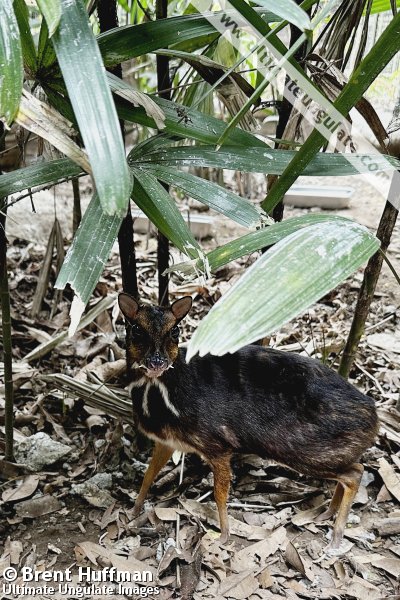
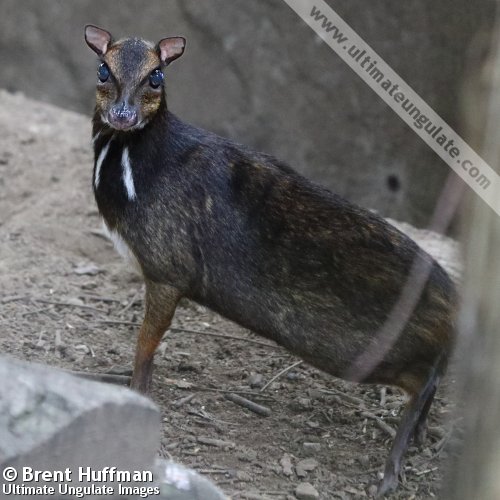
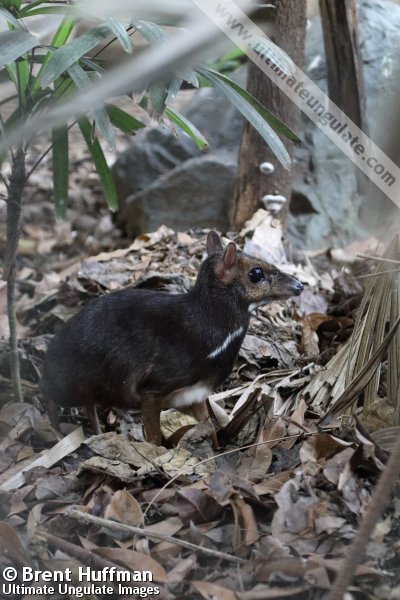
T. nigricans is one of the most darkly-colored chevrotains, with an
overall dark brown coat.(Rabor, 1977; Oliver, 1992). Each individual
hair has sections of different colors - the base is generally light (ranging
from white to ashy brown), with a tawny, orange, or brown midsection, and
a long black tip (Allan and White, 1910; Lydekker, 1915; Rabor, 1977). The
black tips on the hairs give the coat (especially on the upper parts)
a dark-washed look (Lydekker, 1915; Meijaard and Groves, 2004). The
nape of the neck is a mix of predominantly black and fulvous hairs; the hairs
are sometimes arranged into indistinct blackish lines (Rabor, 1977; Meijaard
and Groves, 2004).
The abdominal region is generally orange-brown in color, with the hairs on
the belly also have black tips (Allan and White, 1910; Rabor, 1977).
The lower abdomen, groin, and insides of the thighs are white (Allan
and White, 1910; Rabor, 1977). The hind legs have a white stripe on
their fronts which extends from the upper thigh to the tarsal joint; the
rest of the leg is fulvous in color. The inner surfaces of the front
legs are also white, and this light coloration extends across the chest in
between the front legs as a whitish patch (Allan and White, 1910; Rabor,
1977). The tail is dark brown with a white tip (Allan and White, 1910).
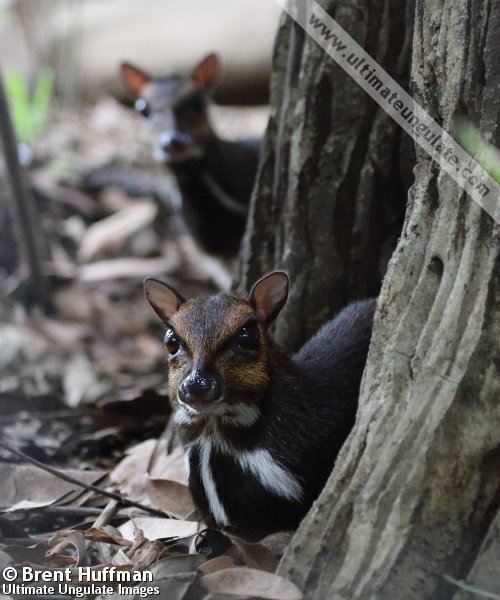
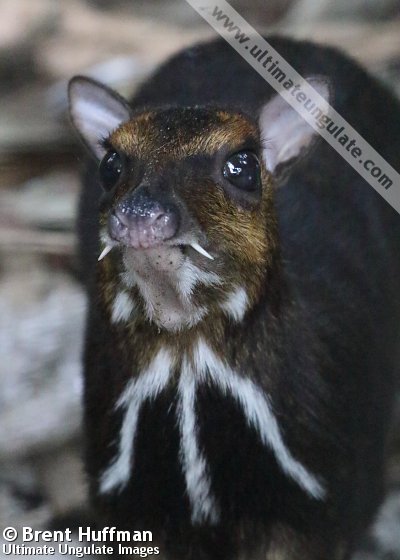
The most striking markings of the Balabac chevrotain are on the throat, with
three narrow white stripes beginning from a white patch under the chin and
extending down towards the chest (Allan and White, 1910; Rabor, 1977). In
intense contrast to these white stripes (and sharply defining them), the
rest of the throat is jet black; in some specimens the black coloration even
overtakes and obscures the stripes (Lydekker, 1915; Rabor, 1977). Towards
the chest, these black and white markings disappear into a broad brown band
which crosses the lower throat (Allan and White, 1910; Rabor, 1977).
The head itself is generally darker in color than the rest of the
body (Rabor, 1977). Broad rufous or fulvous 'eyebrow' stripes
extend from the anterior corners of the eyes to the base of ears. The
bridge of the nose and forehead are dark brown, becoming increasingly infused
with black towards the crown of the head. The sides of the head
are more fulvous (Allan and White, 1910). A naked glandular patch on
underside of jaw is bordered with white, which runs into the white patch
at the top of the throat (Allan and White, 1910; Lydekker, 1915; Rabor,
1977). There are no horns or antlers, but the upper canines are enlarged
and very sharp; these are the primary defensive weapons of T. nigricans
(Rabor, 1977; Rabor 1986). Skull measurements for this species are
given by Allen and White (1910) and Meijaard and Groves (2004).
Ontogeny and Reproduction
Very little is known about the specific aspects of this species' life
history. Rabor (1986) reports that there is a breeding season (but
makes no mention as to when this occurs), and that the litter size is almost
always one, rarely two. Reports for other members of the genus
Tragulus suggest that the gestation period is 140-177 days, sexual
maturity is reached by 5 months of age, and life span up to 14 years (Nowak,
1991).
Ecology and Behaviour
Rabor (1977 and 1986) provide a brief overview of the ecology of T.
nigricans; unless otherwise noted, the account of ecology and behaviour
is from these two sources.
T. nigricans inhabits both primary and secondary forests on Balabac
island, utilizing both large blocks of forest as well as smaller fragments.
Dense vegetation within the forest interior provides shelter for this
species during the daytime. Nocturnal by nature, these chevrotains
leave their shaded resting spots at night, entering into clearings where
they are more visible (and vulnerable). Most encounters between humans
and the Balabac chevrotain occur along roads at night, when their eye shine
is frequently observed from vehicles. This species acts like the proverbial
"(mouse)deer in the headlights", normally freezing and staring into the light
for an extended period of time before fleeing. This species is occasionally
seen at the seashore. Like most chevrotains, T. nigricans is
solitary, although pairs are occasionally seen. This species feeds
mainly on leaves.
Distribution
T. nigricans is endemic to Balabac island in the Palawan chain of
the Philippines, located between Borneo and the island of Palawan (Rabor,
1977; Oliver, 1992). Several attempts to introduce this species to
the island of Palawan have not been successful (Rabor, 1977 and 1986), although
Oliver (1992) mentions unconfirmed reports that a population may have become
naturalized in South Palawan. Rabor (1977) mentions that this species
was also introduced (but without any successful breeding) to "the smaller
island north of [Palawan]" (potentially Calauit?). A captive breeding
program was initiated on Calauit in 1982 and was able to sustain a population
at least until 1992 (see Oliver, 1992), although the present status of this
population has not been reported.
Countries: Philippines (IUCN, 2006).
Range Map (Redrawn from Meijaard and Groves, 2004)
Conservation Status
The Balabac chevrotain is classified (under T. napu nigricans) as
endangered (Criteria B1+2ce) by the IUCN (2006). No members of the
family Tragulidae are listed by CITES (2007). This status of this species
in the wild has never been methodically determined, and no estimates of
population numbers are available. Nonetheless, population numbers have
been greatly reduced over the past several decades through extensive habitat
loss and intense hunting (Rabor, 1977; Oliver, 1992). The Balabac
chevrotain is hunted by locals using guns or snares; the meat is considered
a delicacy and the skin is used for leather (Rabor, 1977; Rabor 1986).
Remarks
The genus name Tragulus means "little goat", derived from
Tragos (Greek) a goat and the diminutive suffix -ulus (Latin).
The species name nigricans is a Latin adjective meaning blackish
(from niger (Latin): black), referring to the dark coloration of this
species.
Named after the island to which it is native, the Balabac chevrotain is also
known as the Philippine chevrotain (or mouse deer) - it is the only member
of the family Tragulidae to inhabit the Philippines (Rabor, 1977).
-
-
Local names
-
Pilandok [Palawan, Balabac] from Rabor, 1986.
-
|
Literature
Cited
Allen, J. A., and J. R. White. 1910. Mammals from Palawan Island,
Philippine Islands. Bulletin of the AMNH; 28: 13-17.
CITES (Convention on the International Trade in Endangered Species of Wild
Flora and Fauna). 2007. Appendix I, II, and III as adopted by the Conference
of the Parties, valid from 3 May 2007.
Available online.
IUCN (International Union for Conservation of Nature and Natural Resources).
2006. 2006 IUCN Red List of Threatened Species.
Available online.
Lydekker, R. 1915. Catalogue of the Ungulate Mammals in the British
Museum of Natural History, Volume IV. London: the Order of the
Trustees of the British Museum.
Meijaard, E., and C. P. Groves. 2004. A taxonomic revision of
the Tragulus mouse-deer (Artiodactyla). Journal of the Linnean
Society of London; 140(1): 63-102.
Nowak, R. M. [editor]. 1991. Walker's Mammals of the World (Fifth Edition).
Baltimore: The Johns Hopkins University Press.
Oliver, W. L. R. 1992. Threatened endemic Artiodactyla of the Philippines:
status and future priorities. International Zoo Yearbook; 32: 131144.
Rabor, D. S. 1977. Philippine Birds and Mammals: A project of
the U. P. Science Education Center. Quezon City: University of Philippines
Press.
Rabor, D. S. 1986. Guide to the Philippine Flora and Fauna, Vol. XI: Birds,
Mammals. Natural Resources Management Centre, Ministry of Natural Resources
and Univ. of the Philippines.
Additional Resources
*Alviola, P. L., III. 1998. Land vertebrates of Calauit Island,
Palawan, Philippines. Asia Life Sciences; 7(2): 157-170.
*Anon. 1993. Status of the Balabac chevrotain Tragulus
(napu?) nigricans. IUCN/SSC Deer Specialist Group Newsletter
11: 4.
*Dobroruka, L. J. 1972. Zur Frage der Inselmelanismen bein
Großkantschil, Tragulus napu F. Cuvier, 1822. Zoologischer
Anzeiger; 188(1-2): 36-39.
*Steere, J. B. 1888. A Month in Palawan. The American
Naturalist; 22(254): 142-145
Timm, R. M., and E. C. Birney. 1980. Mammals Collected by the
Menage Scientific Expedition to the Philippine Islands and Borneo, 1890-1893.
Journal of Mammalogy; 61(3): 566-571.
|
|