Return Home

An Ultimate Ungulate Fact Sheet: Discover the ungulates of the world!
 Sus cebifrons
 Visayan warty pig

Taxonomy | Description | Reproduction | Ecology | Behavior | Distribution | Conservation | Remarks | Literature

Taxonomy
Classification
 

Kingdom :
Phylum :
Class :
Order :
Suborder :
Family :
Tribe :
Genus :

Animalia
Chordata
Mammalia
Cetartiodactyla
Suiformes
Suidae
Suini
Sus

Sus cebifrons [Heude, 1888].
Citation: Mem. Hist. Nat. Emp. Chin., 2, pl. 17, fig. 5.
Type locality: Philippines, Cebu Island.

The taxonomic record (above) is taken from Wilson and Reeder (1993).  Wild pig taxonomy has changed significantly in recent years: only in 1993 did Sus cebifrons become widely recognized as a separate species.  Prior to this, the Visayan warty pig was considered by various authors to be a subspecies of either the Sulawesi warty pig (i.e. Sus celebensis negrinus) or the bearded pig (Sus barbatus cebifrons; see Groves, 1997).  Given its history of being included within other pig species, it is perhaps surprising that recent molecular research indicates that this species is possibly the most genetically distinct member of genus Sus (Oliver, 2004b)

Some authors consider the Visayan warty pig to be monotypic (Groves and Grubb, 1993), while other recognize two subspecies based on islands of origin: S. c. cebifrons, now extinct from Cebu, and S. c. negrinus from Negros (Groves, 1997).  A third subspecies from Panay may exist, but the required studies on body and skull morphology have not yet been conducted (Oliver, 2004a).  S. negrinus is a synonym for S. cebifrons (Wilson and Reeder, 1993).

Click on the pictures above for a larger view of the photographs

General Characteristics

Like many island species, the Visayan warty pig is relatively small in size (Oliver et al., 1993).  Males are much larger than females, with up to a four-fold difference in body weights between the sexes (Rabor, 1977; Lastica, 2003).  These pigs are usually lean, but can become obese in captivity (Lastica, 2006).

Reported measurements for Visayan warty pig (Sus cebifrons)

Source                   Adult Weight   Head & Body Length    Shoulder Height     Tail Length 
Lastica, 2003

35-40 kg
20-35 kg

-

-

-

Lastica, 2006
Estimates from Negros

up to 80 kg 
20-35 kg

-  

up to 50-55 cm
30-45 cm  

 -

Rabor, 1977
for S. c. negrinus

-

114 cm
95.7 cm

63 cm
45.6 cm

23 cm

S. cebifrons is dark grey or black in overall color (Groves, 1997; Lastica, 2003).  Sparse bristly hairs cover most of the body - in females and young males these are predominantly black in color, while in adult males there is often a predominance of silver- of fawn-colored bristles (Rabor, 1977; Groves, 1997; Lastica, 2003).  Skins of adult males from Negros have an especial predominance of white hair on the shoulders and sides (Groves and Grubb, 1993).  A tuft of hair is usually present on the crown of the head; this tends to be either dark reddish-brown or black with scattered red or straw-colored hairs (Groves, 1997).  In males (and females to a lesser extent) from Panay, this tuft is expanded into a long mane which extends from the forehead down the back to the rump (Groves and Grubb, 1993).  This mane is grown and shed annually, and is one of the most distinctive characters of this species, often flopping over the face of the boar, obscuring the eyes.

The body is typical of pigs, being barrel-like in form with relatively short legs.  Females possess three pairs of mammary glands (also present, but not functional, in males).  Other native and domestic Filipino pigs - as well as hybrids between these species and S. cebifrons - possess at least four pairs, providing an important key in the identification of purebred Visayan warty pigs (Lastica, 2003).

The high-crowned skull is relatively small in both sexes, and sexual dimorphism is highly evident in skull morphology (Groves, 1997).  Groves and Grubb (1993) provide a few cranial measurements.  Externally, the head is elongated with a terminal nasal disc.  The ears are small and upright, with slightly pointed tips (Lastica, 2003).  Despite being named a "warty pig", the facial warts of S. cebifrons are typically small; males from Panay have the largest warts (Groves and Grubb, 1993; Groves, 1997).  Visayan warty pigs never grow gonial warts (on the angle of the jaw) - this spot is marked in males by a wide white tuft of hair; in females, there is usually no tuft and only a small white spot present (Groves and Grubb, 1993; Groves, 1997).  Male Visayan warty pigs possess large canines which protrude from the mouth as tusks (Lastica, 2003).

In both sexes, the face is marked with a conspicuous whitish stripe which crosses the bridge of the nose just behind the mouth and follows the jawline to the angle of the jaw (Groves, 1997; Lastica, 2003).  This band is generally less obvious in females than males, but is one of the primary distinguishing characteristics for distinguishing S. cebifrons from other Philippine wild pigs (Lastica, 2003).

Ontogeny and Reproduction

The gestation period for S. cebifrons is approximately 118 days (Oliver, 1996 in Lastica, 2003).  One to two weeks prior to giving birth, females begin showing nesting behavior and may become aggressive to conspecifics (Oliver et al., 1993).  Females usually give birth overnight, and are very protective of their offspring (Lastica, 2003).  Reports from native hunters indicate that the average number of piglets per litter in the wild is three or four (Oliver et al., 1993), while Lastica (2003) suggests average litter size is two or three.  These figures are corroborated by captive births: six of ten North American captive-born litters contained three offspring, with half of the remaining four litters contained two and four offspring each (ISIS, 2005).  A record number of five offspring in a litter was observed in two Philippine breeding centers in 2005, although the piglets had to be weaned earlier than usual to help the female regain condition (Lastica, 2007).  In the wild, piglets are usually observed from January to March, during the region's dry season (Oliver et al., 1993).

Young Visayan warty pigs are marked with thick stripes which run from the shoulders to the rump, alternating between orange-brown and black (Groves, 1997; Lastica, 2003).  There are typically four black stripes; one pair runs down the back on either side of a lighter dorsal line, with another stripe running on either side along the flanks and haunches (Groves, 1997).  The striping of the juvenile coat loses definition at seven to nine months of age, and adult coloration is fully achieved after one year (Rabor, 1977; Lastica, 2003).  Youngsters begin testing solid food at one week of age, and may be weaned by six months (Lastica, 2003).  Females are capable of producing a litter every 8 to 12 months (ISIS, 2005).

Females reach sexual maturity at two or three years of age; males may be sexually mature at two years, but do not possess the fully-developed characteristics of adult males (Lastica, 2003).  In the wild, Visayan warty pigs are believed to live up to 10-15 years (Lastica, 2003).

Ecology and Behavior

Knowledge of the Visayan warty pig from the wild is very scarce, due to the rarity of this species, the scarcity of natural habitat, and the difficulties of observing these animals in the wild.  This species was once found in a wide variety of habitats, ranging from lowland and highland grasslands as well as primary and secondary forest (Rabor, 1977).  This species is now restricted to densely forested areas on just two islands in the Philippines (Rabor, 1977).

This species is sociable, living in groups of three to over a dozen animals.  The composition of these groups is typically a single adult male with several females (usually three or four, as indicated by local hunters) and young individuals of both sexes (Rabor, 1977; Oliver et al., 1993).  Solitary males have also been reported, but are encountered only rarely (Oliver et al., 1993).

In captivity, S. cebifrons will use mud wallows (Lastica, 2003).  While pigs are generally not excellent jumpers, one juvenile female on Negros was observed clearing a meter-high fence during a capture attempt (Lastica, 2003).

S. cebifrons, like most pig species, is omnivorous (Lastica, 2003).  As determined though indirect observations of tracks and scat, Visayan warty pigs appear to feed on plant species such as Lithocarpus (Fagaceae), Platea excelsa (Icainaceae), and Dillenia reifferscheidia (Dilleniaceae) (Hamann and Curio, 1999).  These authors suggest that Lithocarpus and Dillenia may depend solely on S. cebifrons for seed dispersal.  Other plant species identified in the diet by Cummings (2003, in Lastica, 2003) include "Gabe gabe" and "Silan" (Colocasia sp. - a favorite of this species), "Lintakuban" (a fruiting tree), "Kagay" vine, "Tugis" palms, wild bananas, avocado, "Batwan", "Lumboy lumboy", and casava.  Earthworms ("Duduloy") are frequently consumed (Cummings, 2003, in Lastica, 2003).

Distribution

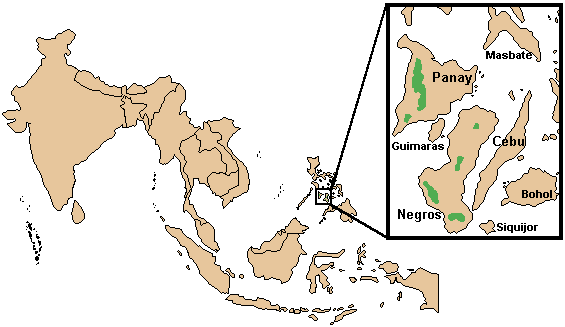
S. cebifrons is endemic to the Negros faunal region of the Philippines, encompassing the Visayan Islands of Cebu (where it is now extinct), Negros, Panay, and Guimaras (now extinct) (Groves and Grubb, 1993).  This species may also be present on the island of Masbate, and may once have lived on Siquijor and Bohol (where it is now believed to be extinct) (Oliver, 1995).

Countries: Philippines (IUCN, 2004).

Range Map (Redrawn from Oliver, 1995)

Conservation Status

The Visayan warty pig has been listed as critically endangered (Criteria A1cde, B1+2acd, E) by the IUCN (2006), but is not listed by CITES.  It is one of the most endangered species of wild pig, being extinct in over 95% of its former range and now found only in small, fragmented populations (Oliver, 2004a; Oliver, 2004b).  There have been no recent published estimates of population numbers surviving in the wild.

While small isolated populations face numerous problems sustaining their numbers, in the case of the Visayan warty pig there are far more pressing concerns.  Human impacts - including habitat destruction, persecution (a result of crop raiding), and intensive hunting for meat - continue to reduce both absolute numbers of Visayan warty pigs and their potential to maintain (nevermind expand) their numbers by reducing available resources (Oliver, 2004b; IUCN 2006).  Domestic pigs pose a significant threat to this species, hybridizing with wild warty pigs as well as introducing diseases and parasites.  Visayan warty pigs killed by poachers now show (with increasing frequency) obvious hybrid characters, including large ears, reduced manes, and even piebald markings (Oliver, 2004a).  Three rescue and breeding centers for this species have been created within the Philippines, and an international breeding program is underway, with captive stock in both North America and Europe (Oliver, 2004a; Oliver 2004b).

Remarks

Sus is Latin, meaning a pig.  The species name cebifrons is likely a combination of Cebu (the island on which the type specimen was collected), and the Latin word frons, meaning the forehead or brow, a reference to the long mane and forehead tuft.  Although now extinct on the island of Cebu, S. cebifrons is sometimes called the Cebu bearded pig as a result of the provenance of the type specimen.  

Local names
Baboy ilahas (on Visayas; literally "wild pig") from Rabor, 1977; Lastica, 2003; Lastica, 2007
Baboy do mor [Local Philippine dialect] from Oliver, 2004a
Baboy talunon (on Negros) from Lastica, 2003
Manggalisak banban (half-grown male in Bisayan) from Rabor, 1977 
Biggal (sow in Bisayan) from Rabor, 1977 
Bakatin (small pig in Bisayan) from Rabor, 1977 
Literature Cited
Groves, C. P.  1997.  Taxonomy of wild pigs (Sus) of the Philippines.   Zoological Journal of the Linnean Society; 120(2): 163-191

Groves, C. P., and P. Grubb.  1993.  The Eurasian suids, Sus and Babyrousa - Taxonomy and Description.  In Pigs, Peccaries and Hippos: Status Survey and Action Plan.  Edited by W. L. R. Oliver.   Gland, Switzerland: IUCN.  pp. 129-136.  Available online.

Hamann, A. and E. Curio.  1999.  Interactions among frugivores and fleshy fruit trees in a Philippine submontane rainforest.  Conservation Biology; 13(4): 766-773.

ISIS (International Species Information System).  2005 Specimen Records.

IUCN (International Union for Conservation of Nature and Natural Resources).  2006.  2006 IUCN Red List of Threatened Species.  Available online.

Lastica, E. A.  2003.  Visayan Warty Pig (Sus cebifrons) - Species husbandry guidelines.  Philippines Biodiversity Conservation Programmes.

Lastica, E. A.  2006.  Personal Communication (February 2006).  Programme Assistant, Philippines Biodiversity Conservation Programmes; Consultant Curator, Silliman University - Center for Tropical Conservation Studies

Lastica, E. A.  2007.  Personal Communication (June 2007).  Coordinator of the Threatened Species Conservation Breeding Programmes, Philippines Biodiversity Conservation Programme; Consultant Curator, Silliman University - Center for Tropical Conservation Studies

Oliver, W. L. R., C. R. Cox, and C. P. Groves.  1993.  The Philippine Warty Pigs (Sus philippensis and S. cebifrons).  In Pigs, Peccaries and Hippos: Status Survey and Action Plan.  Edited by W. L. R. Oliver.   Gland, Switzerland: IUCN.  pp. 145-155.  Available online.

Oliver, W. L. R. 1995.  The taxonomy, distribution and status of Philippine wild pigs.  IBEX (Journal of Mountain Ecology); 3: 26-32.

Oliver, W. L. R. 2004a.  First (and last?) breeding loan export of Visayan (Negros) warty pigs.  Suiform Soundings (PPHSG Newsletter); 4(1): 25-27.

Oliver, W. [Compiler].  2004b.  Summary of group activities during the past quadrennium.  Suiform Soundings (PPHSG Newsletter); 4(2): 43-45.

Rabor, D. S.  1977.  Philippine Birds and Mammals. University of the Philippines Press, Quezon City, Philippines.

Wilson, D. E., and D. M. Reeder [editors]. 1993. Mammal Species of the World (Second Edition). Washington: Smithsonian Institution Press.  Available online.

Additional Resources

*Blouch, R. A.  1995.  Conservation and research priorities for threatened suids of South and Southeast Asia.  Journal of Mountain Ecology; 3: 21-25.

Catibog-Sinha, C. S. 1978. Wild pigs (Sus celebensis ssp.) in the Philippines (Part 2).  In Wild Plants as Potential Feeds for Wild Pigs; Ready References, Monograph No. 5; Forest Research Institute, College, Laguna, Philippines.  pp. 17-29.

Catibog-Sinha, C. S. 1981. The quantity and quality of wild food plants and the depredations of wild pigs in the Philippines. (Unpubl.) Ph.D. thesis, Oklahoma State University, Stillwater, Oklahoma: 237 pp.

Cox, C. R. 1985.  A field survey of the distribution and conservation status of the wild pig (Sus barbatus cebifrons) and Prince Alfred's spotted rusa (Cervus alfredi) in the Visayan Islands, Republic of the Philippines. (Unpubl.) report to the IUCN/SSC Pigs and Peccaries Specialist Group: 27 pp.

Cox, C. R. 1987.  The Philippines spotted deer and the Visayan warty pig.  Oryx; 21(1): 37-42.

Cox, C. R. 1987.  A preliminary survey of the proposed Panay Mountains National Park. (Unpubl.) report to the Zoologischer Garten Berlin: 44 pp.

Cummings, M. J.  2003.  An Assessment of the Visayan Warty Pig, Sus cebifrons in the Imbang-Caliban Watershed, North Negros Forest Reserve, Philippines: Ecological and Social Perspectives. MSc Conservation Dissertation. University College London.

Forest Management Bureau.  1988.  Natural Forest Resources of the Philippines. Philippine-German Forest Resources Inventory Project, Forest Management Bureau, Dept. of the Environment and Natural Resources, Manila: 62 pp.

Groves, C. P.  1981.  Ancestors for the Pigs: Taxonomy and Phylogeny of the Genus Sus.  Tech. Bull. No. 3, Dept. of Prehistory, Research School of Pacific Studies, Australian National University, Canberra: 96 pp.

Groves, C. P.  1991.  Wild pig skulls from Mt. Talinis, Southeast Negros. (Unpubl.) report to British Museum (Natural History). 2 pp.

Heaney, L. R.  1986.  Biogeography of mammals of Southeast Asia: estimates of rates of colonisation, extinction and speciation. Biol. J. Linnaen Society; 28: 127-165.

*Lucchini, V., E. Meijaard, C. H. Diong, C. P. Groves, and E. Randi.  2005.  New phylogenetic perspectives among species of South-east Asian wild pig (Sus sp.) based on mtDNA sequences and morphometric data.  Journal of Zoology; 266(1): 25-35

MacKinnon, J., and K. MacKinnon.  1986.  Review of the Protected Areas System in the Indo-Malayan Realm. IUCN, Gland and Cambridge: 284 pp.

McGowan, P.  1986.  Pigs and Palawan.  Unpublished report to IUCN/SSC Pigs and Peccaries Specialist Group: 4 pp.

Mohr, E.  1960.  Wilde Schweine (Neue Brehm-Bücherei no. 247).  Wittenberg-Lutherstadt: Ziemsen Verlag.

*Mudar, K. M.  1986.  A morphometric analysis of the five subspecies of Sus barbatus, the bearded pig.  (Unpubl.) M.Sc. thesis, Michigan State University.

Oliver, W. L. R.  1991.  The skulls from Mt. Talinis, IUCN/SSC Pigs and Peccaries Specialist Group report. Species 16:

**Oliver, W. L. R.  1992.  The taxonomy, distribution and status of Philippine wild pigs.  Silliman Journal; 36(1): 55-64.

*Oliver, W. L. R.  1993.  Threatened endemic artiodactyls of the Philippines: status and future priorities.  International Zoo Yearbook; 32:131-144.

Oliver, W. L. R. 1996. Summary of recent research on Philippine wild pigs and continued development of the Visayan Warty Pig (Sus cebifrons) Conservation Program.  (Unpubl.) report to the DENR and Zoological Society of San Diego: 29 pp.

Oliver, W. L. R. and R. Wirth.  1996.  Conservation programmes for threatened endemic species in the Philippines.  International Zoo News; 43(5): 337-348.

Oliver, W. L. R., C. R. Cox, and L. Dolar.  1991.  The Philippine Spotted Deer, Cervus alfredi, Conservation Project.  Oryx; 25(4): 199-205.

Quinnell, R., and A. Balmford.  1988.  A future for Palawan's forests?  Oryx; 22(1): 30-35.

Rabor, D. S.  1986.  Guide to the Philippine Flora and Fauna, Vol. XI: Birds, Mammals. Natural Resources Management Centre, Ministry of Natural Resources and Univ. of the Philippines: 161-164.

**Wu Gui-sheng, Pang Jun-feng, and Zhang Ya-ping.  2006.  Molecular phylogeny and phylogeography of Suidae.  Zoological Research; 27(2): 197-201.

HomeUngulates of the World
© Brent Huffman, www.ultimateungulate.com
All rights reserved.
Questions or comments? Click here