Return Home

An Ultimate Ungulate Fact Sheet: Discover the ungulates of the world!
 Neotragus pygmaeus
 Royal antelope

Taxonomy | Description | Reproduction | Ecology | Behavior | Distribution | Conservation | Remarks | Literature

Taxonomy
Classification
 

Kingdom :
Phylum :
Class :
Order :
Suborder :
Family :
Subfamily :
Tribe :
Genus :

Animalia
Chordata
Mammalia
Cetartiodactyla
Ruminantia
Bovidae
Antilopinae (?)
Neotragini (?)
Neotragus

Neotragus pygmaeus [Linnaeus, 1758].
Citation: Syst. Nat., 10th ed., 1:69.
Type locality: "Guinea, India" (= west coast of Africa).

The initial taxonomic record (above) is taken from Wilson and Reeder (1993).  Originally named Capra pygmaea, the spelling of the royal antelope's scientific name is inconsistent, with some authors dropping the "a" in the species to form Neotragus pygmeus (Wilson and Reeder, 1993).  However, due to general consensus, N. pygmaeus is used here.  The royal antelope is the only member of the subgenus Neotragus (see Nowak, 1991).  The species is monotypic (no described subspecies) and has no synonyms (see Wilson and Reeder, 1993).

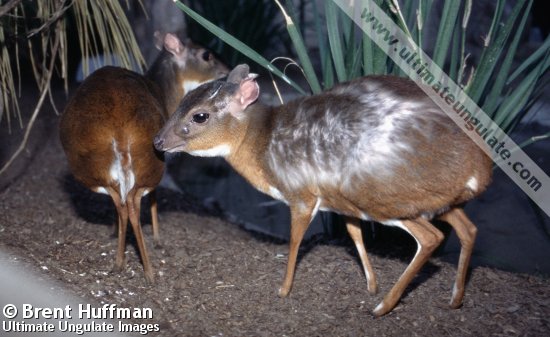
Click on the pictures above for a larger view of the photographs

General Characteristics

The tiny royal antelope has the distinction of being the smallest African ungulate, the smallest bovid, and vies for the title of smallest ungulate with mouse deer (Tragulus) (Happold, 1973; Nowak, 1991).  Adults are typically less than 3 kilograms in weight, 50 cm long, and 25 cm high at the shoulder.

Reported measurements for royal antelope (Neotragus pygmaeus)

Source                   Adult Weight   Head & Body Length    Shoulder Height     Tail Length 
Benirschke, 2005

2.45 kg
(pregnant )

-

-

-

Happold, 1973

2-3 kg

38-51 cm

25 cm

5-8 cm

Kingdon, 1997

1.5-3 kg

38-51 cm

24-26 cm

5-8 cm

Nowak, 1991

-

50 cm

25-30.5 cm

7.5 cm

Owen, 1973

2.4 kg

43 cm

26 cm

5 cm

Walther, 1990

1.8-2.5 kg

40-50 cm

25 cm

5-8 cm

The coat of N. pygmaeus is soft and sleek (Happold, 1973).  The general coloration is a golden brown, cinnamon, or russet, becoming slightly paler on the lower sides (Happold, 1973; Nowak, 1991; Kingdon, 1997).  The underparts, including the chin, throat, and insides of the hind legs, are white (Happold, 1973; Nowak, 1991; Kingdon, 1997).  Across the throat runs a band of rufous brown (the same as the upperparts) which bisects the white coloration on the underside of the neck like a collar (Happold, 1973; Kingdon, 1997).  The tail is thin and small, being mostly white, except for a thin stripe of color on the dorsal surface (Happold, 1973; Kingdon, 1997).  The tail terminates with an entirely white tuft (Nowak, 1991).

The royal antelope has a compact build with thin, relatively long legs (Kingdon, 1997).  The hind limbs are longer than forelimbs, and are typically tucked under the body, raising the hindquarters (Happold, 1973; Nowak, 1991).  This provides a more streamlined shape, and enables the hind legs to provide tremendous thrusting force should the need to flee arise (Happold, 1973; Nowak, 1991).  There is a white spot on the front surface of each leg, just above the hooves (Happold, 1973).  N. pygmaeus lacks dewclaws (Nowak, 1991).  Females have four teats (Walther, 1990; Nowak, 1991).

N. pygmaeus has no distinctive facial markings.  The round, dark-brown eyes are large and preorbital glands are present (Owen, 1973; Walther, 1990; Kingdon, 1997).  The muzzle is petite and the large rhinarium is grey-pink in color (Owen, 1973; Walther, 1990; Kingdon, 1997).  The rounded ears are translucent, with the inner surface being flesh-colored (Owen, 1973; Kingdon, 1997).  There is no tuft of hair on the forehead (Walther, 1990).  Male royal antelope have one pair of short, conical horns (Happold, 1973; Nowak, 1991; Kingdon, 1997).  Black in color and lacking any ridges, the smooth horns point backwards, following the angle of forehead (Happold, 1973; Walther, 1990; Nowak, 1991).  Like everything else with this species, the horns are small, growing 1.2-2.5 cm, or occasionally up to 3.5 cm, in length (Walther, 1990; Nowak, 1991).

Ontogeny and Reproduction

Little is known about the breeding of the royal antelope.  In the wild, births allegedly occur in November and December (Walther, 1990), a date supported by a juvenile acquired by Owens (1973).  There is typically one young per litter (Walther, 1990; Benirschke, 2005).  Walther (1990) gives weight at birth as 0.8-1.0 kg - un unreasonably high figure, considering this is over one third of an adult's body weight (Walther, 1990).  Benirschke (2005) estimated the birth weight of a captive-born youngster to be 300 grams or less.  Young are fragile, and have the same coloration as adults (see Benirschke, 2005).  The preorbital glands open at about three months of age (Owen, 1973).

Weaning reportedly occurs around 2 months of age (Owens, 1973; Walther, 1990; Kingdon, 1997).  A young captive observed by Owens (1973) began ruminating at four months of age, an had settled into a typical ruminant feeding pattern (eating quickly while food is available, then ruminating at a later time) by six months.  Sexual maturity is attained after one year of age (Walther, 1990; Kingdon, 1997).  The longest reported life span for a royal antelope was a captive individual which lived to 6 years, 8 months (Jones, 1993).

Ecology and Behavior

N. pygmaeus is a forest-dwelling species, typically found in rainforest, tropical dry forest, and galleries in forest-savannah mosaics (Kingdon, 1997; IUCN, 2004).  Areas with dense undergrowth, such as forest edges and clearings, provide cover and are frequently used (Nowak, 1991; Kingdon, 1997).  With increasing human encroachment into their natural habitat, royal antelope are now often found along road verges and cultivated lands (Kingdon, 1997; IUCN, 2004).

Ecologically, N. pygmaeus is believed to occupy a niche similar to the closely related Bates' antelope (Neotragus batesi), found in Central African forests   (Happold, 1973).  No ecological studies have been done with this species, in part due to its shy, secretive nature, and thus most of the information presented here is drawn from anecdotes, inferences, and supposition (Nowak, 1991; IEA, 1998).  The royal antelope is frequently reported as being crepuscular and/or nocturnal, resting and ruminating during the day (Happold, 1973; Walther, 1990).  Kingdon (1997), however, suggests that this species may forage throughout the day, but is most easily seen in the beams of flashlights at night, when it will exit the forest to visit verges and farms (Kingdon, 1997).  Reports that this species lives solitary or in monogamous pairs are frequent (Walther, 1990; Kingdon, 1997).  A pair occupies a small territory estimated to be only 100 square meters in size, which is marked with dung (Walther, 1990; Kingdon, 1997).

Royal antelope move with a high-stepping gait, constantly flicking their tail (Happold, 1973; Kingdon, 1997).  If disturbed, the first response is to crouch and hide under cover (Happold, 1973).  If the threat continues to approach, royal antelope will wait until it is nearly on top of them before taking flight (Nowak, 1991).  This species can move very rapidly through dense cover, dodging and twisting, and disappearing quickly from view (Happold, 1973; Nowak, 1991).  There are two distinct methods of fleeing, either a fast run with the body held low to the ground and the head thrust forward or with powerful high jumps (Happold, 1973; Kingdon, 1997).  The long hind legs provide incredible power, and N. pygmaeus is reported to leap as far as 2.8 meters in a single bound, and as high as 55 cm from a standing start (Owen, 1973; Nowak, 1991).  Royal antelope are preyed upon by numerous predators - virtually anything larger than its diminutive size, including raptors and large snakes (Walther, 1990).

The diet of N. pygmaeus consists of fresh leaves, buds, and shoots (Kingdon, 1997).  Fruits, fungi, and flowers are fed upon less frequently, and grasses and herbs are eaten only rarely (Walther, 1990; Nowak, 1991; Kingdon, 1997).  A captive royal antelope observed by Owen (1973) given free-range outdoors preferred eating Blepharis maderaspatensis and Asystasia gangetica (Acanthaceae), and Tridax procumbens (Compositae).  Other plants were eaten in limited quantities, including grasses, sedges, Vernonia cinerea (Compositae), Canscora decussara (Gentianaceae), Alternanthera (Amarantaceae), Borreria (Rubiaceae), Desmodium (Papilionaceae), Euphorbia prostrata (Euphorbiaceae), and Solenostemon ocymoides (Labiatae).  Although Kingdon (1997) reported that leaves are plucked using the mouth and long tongue, Owens (1973) observed leaves to be bitten cleanly off the parent plant, with the tongue playing a very minor roll in acquiring and chwing vegetation.

Distribution

N. pygmaeus is found in the Guinea forest block along the southern coast of west Africa (Owen, 1973).  Specimens have been recorded at elevations up to 2,000 meters above sea level (Happold, 1973).

Countries: Côte d'Ivoire, Ghana, Guinea, Liberia, and Sierra Leone (IUCN, 2004).  

Range Map (Redrawn from IEA, 1998)

Conservation Status

N. pygmaeus is classified as a low risk, near threatened species by the IUCN (2004), and is not listed by CITES.  The wild population has been estimated at 62,000 individuals, although the authors suggest that this may be a significant underestimate due to the difficulty of censusing such a shy creature (East, 1999)   Royal antelope are threatened by persistent hunting, as well as habitat loss to agriculture (IUCN, 2004).

Remarks

In folklore of Liberia, the royal antelope is a figure renowned for its speed and wiseness (Nowak, 1991).  Because of its size and habits, it is known locally as the "King of the Hares", and it is apparently from this kingly appellation that the common name "royal antelope" was derived (Gotch, 1995)

The genus name Neotragus is from the Greek words neos (meaning new) and tragos (a he-goat).  The English word pygmy, as well as the species name pygmaeus, can be traced to the Greek word for fist - pugme; hence pugmaios (Greek) means "as small as a fist" (Gotch, 1995).

Local names (from Happold, 1973)
Adowa [Twi]
Sagbene [Dyula]
 
French
Antilope royale (Happold, 1973).
 
German
Kleinstböckchen (Happold, 1973).
Literature Cited
Benirschke, K.  2005.  Comparative Placentation: Royal antelope, Neotragus pygmaeus.  Available online http://medicine.ucsd.edu/cpa/rant.htm (Accessed December 6, 2005).

East, R. [compiler]. 1999. African Antelope Database 1998. IUCN/SSC Antelope Specialist Group. Gland, Switzerland and Cambridge, UK: IUCN.

Gotch, A. F.  1995.  Latin names explained: A guide to the scientific classification of reptiles, birds, and mammals.  New York: Facts on File, Inc. 

Happold, D. C. D.  1973.  Large Mammals of West Africa.  London: Longman Group Ltd.

IEA (Institute of Applied Ecology).  1998.  Neotragus pygmaeus.  In African Mammals Databank - A Databank for the Conservation and Management of the African Mammals Vol 1 and 2. Bruxelles: European Commission Directorate. Available online at http://www.gisbau.uniroma1.it/amd/amd183b.html

IUCN (International Union for Conservation of Nature and Natural Resources).  2004.  2004 IUCN Red List of Threatened Species. Available online at http://www.redlist.org/

Jones, M. L.  1993.  Longevity of ungulates in captivity.  International Zoo Yearbook; 32: 159-169.

Kingdon, J. 1997. The Kingdon Field Guide to African Mammals.  Academic Press, London and New York: NaturalWorld.

Owen, J. 1973.  Behavior and diet of a captive royal antelope, Neotragus pygmaeus L.  Mammalia; 37: 56-65.

Walther, F. R.  1990.  Duikers and Dwarf Antelopes.  In Grzimek's Encyclopedia of Mammals.  Edited by S. P. Parker.  New York: McGraw-Hill.  pp. 325-343.

Wilson, D. E., and D. M. Reeder [editors]. 1993. Mammal Species of the World (Second Edition). Washington: Smithsonian Institution Press.  Available online at http://nmnhwww.si.edu/msw/

HomeUngulates of the World
© Brent Huffman, www.ultimateungulate.com
All rights reserved.
Questions or comments? Click here