
Kingdom: |
Animalia Chordata Mammalia Artiodactyla Suiformes Suidae Suini Sus |
Common name:
Scientific name:
Other names: |
Javan warty pig
Sus verrucosus
Javan pig, Sanglier pustule, Sanglier verruqueux de Java, Pustelschwein, Babi tanah |
Physical Characteristics
- Head and body length:
143-190 cm (males), 90-134 cm (females)
- Shoulder height: 70-90 cm
- Tail length: Unreported, "relatively long".
- Adult weight: 80-150 kg (males), 35-60 kg (females)
- Shoulder height: 70-90 cm
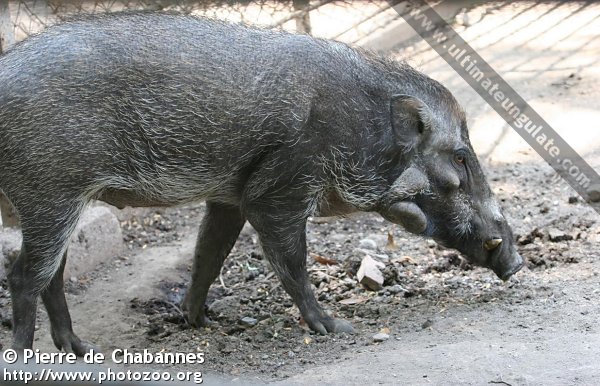
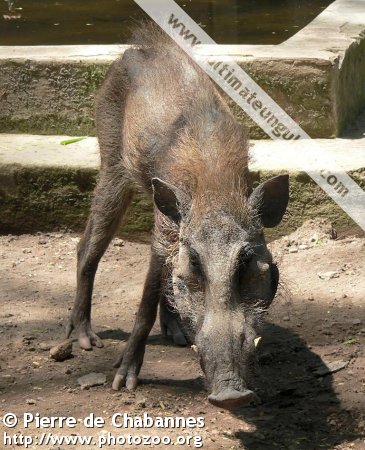
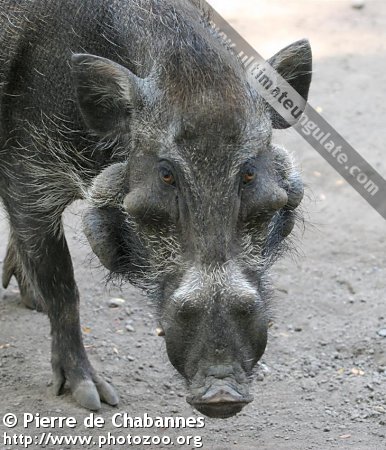
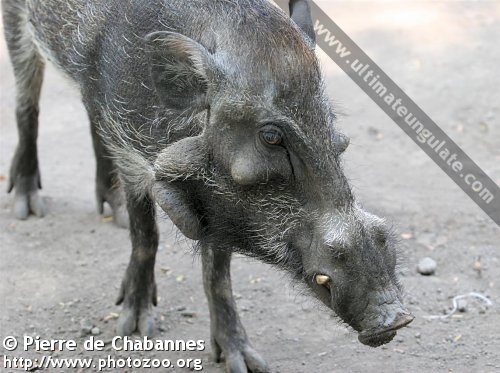
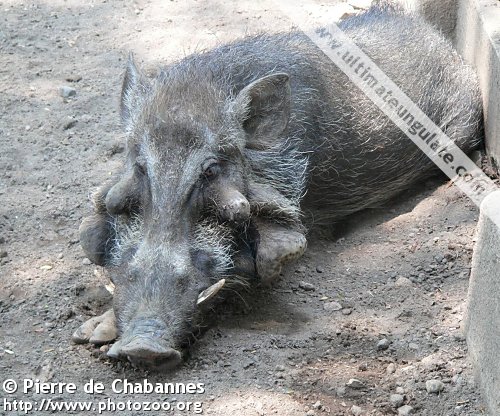
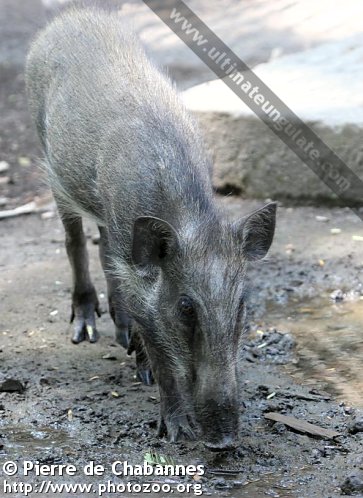
Male Javan warty pigs are much larger than females (approximately twice as heavy), but both sexes have relatively long legs and a straight back. Adults are covered in sparse hair; coloration is generally dark, ranging from ochre-brown to black, but the undersides are pale (yellow or whitish). A mane of longer hair is present on the nape of the neck, and extends along the spine to the rump. Javan warty pigs have relatively long faces; males develop highly distinctive swellings ("warts") beneath their eyes, below the ears, and (the largest) at the angle of the jaw. In younger animals, there is a distinct tuft of hair along the jawline where the last wart will emerge. The large ears have a broad leaf-like shape.
- Similar species
- The Eurasian wild pig (Sus scrofa) is also found on Java, and many early reports do not distinguish between the two species. Female and juvenile Javan warty pigs are "almost indistinguishable" from male and female Eurasian wild pigs in the field, but male warty pigs are readily identified by their much larger size and characteristic warts.
Reproduction and Development
- Gestation period:
Estimated around 4 months.
- Litter size: 4-6 (from two observations), possibly 3-9.
- Weaning: Unknown.
- Sexual maturity: Unknown.
- Life span: Up to 14 years.
- Litter size: 4-6 (from two observations), possibly 3-9.
Breeding is reportedly season. One report indicates that most births occur during the rainy season (January-March); however, recent hunter reports indicate that females accompanied by young are most frequently seen between August and December. Females construct a large nest out of leaf litter in which to give birth. The piglets of the Javan warty pig are marked with very indistinct pale stripes or spots (unlike the bold markings of infant Eurasian wild pigs, Sus scrofa), and these disappear very quickly.
Ecology and Behavior
- Family group:
Small female+young groups, usually with no more 6 animals. Group size may have formerly been as high as 10 or 20.
Adult males are solitary.
- Diet: Omnivorous.
- Main Predators: Leopard, dhole; formerly Javan tiger (prior to its extinction in the 1970s).
- Diet: Omnivorous.
Habitat and Distribution
Javan warty pigs prefer secondary forests (forest with undergrowth), especially those dominated by teak. The range of this species appears to be restricted below 800 m, although historical records indicate that they once have been present up to 1,500 m. This species is endemic to the islands of Java (S. verrucosus verrucosus) and Bawean (S. v. blouchi); it was formerly found on Madura, but is now thought to be extinct there. The approximate range is depicted in the map below.

Conservation Status
- IUCN Red List:
Endangered (2008).
- CITES Listing: Not listed (2011).
- Threats: Hunting, poisoning (considered a pest), habitat loss, and potentially hybridization and competition with native Eurasian wild pigs (Sus scrofa vittatus).
- CITES Listing: Not listed (2011).
The Javan warty pig is now found in small, fragmented populations in small pockets of habitat. Widespread hunting and poisoning of these pigs is a major threat: between 1982 and 2006, 17 of the 32 populations (53%) either became extinct or were severely reduced. There are no estimates of population size.